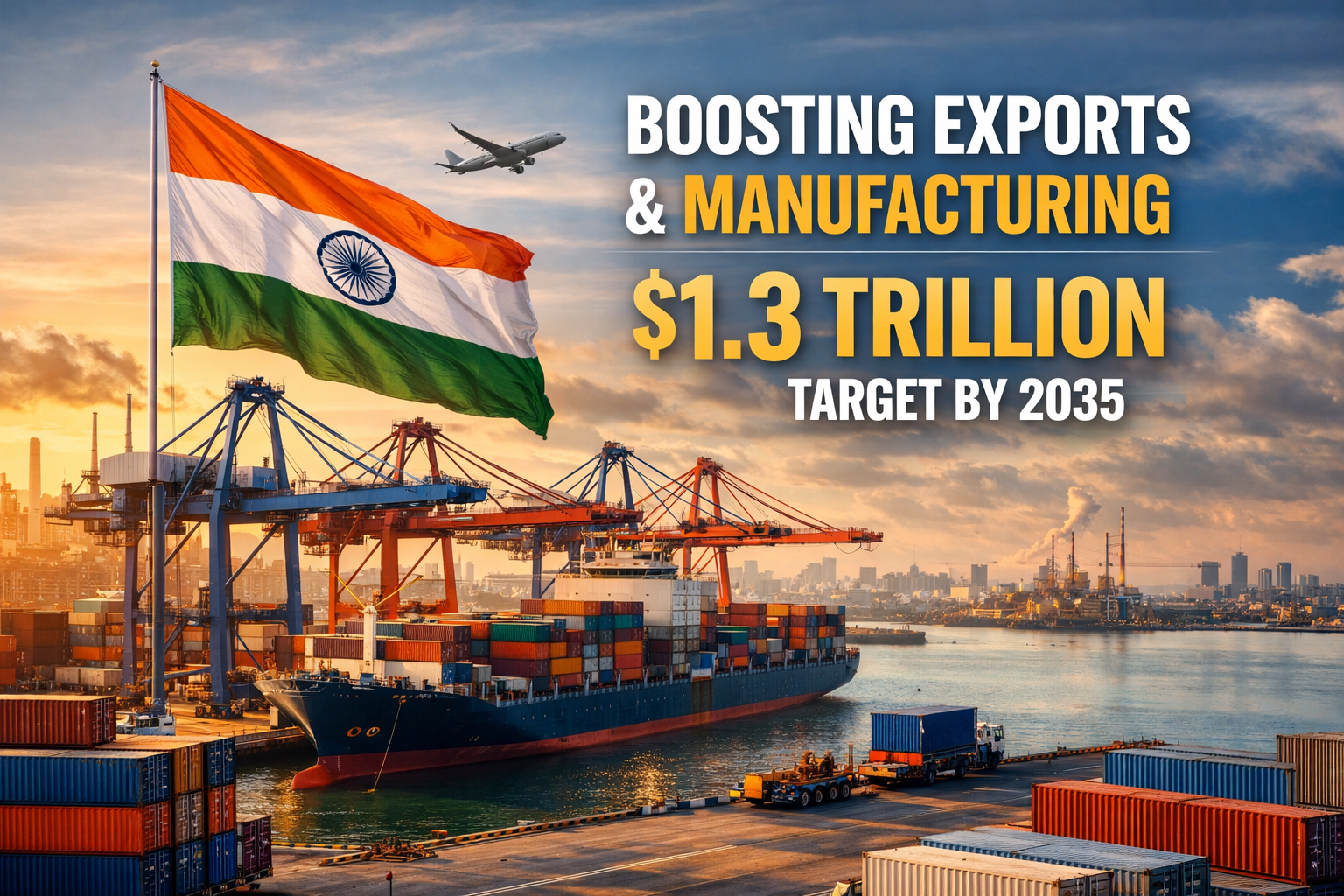
India has outlined a major strategic push to strengthen its manufacturing base and significantly expand exports, with the government setting an ambitious long-term goal of reaching USD 1.3 trillion in annual goods exports. The initiative is centered on large-scale deregulation, policy simplification, and improved ease of doing business rather than heavy reliance on subsidy-driven incentives.
The move reflects a shift in India’s industrial strategy as authorities aim to enhance global competitiveness, attract investment, and integrate domestic manufacturers more deeply into international supply chains. Senior officials involved in the policy formulation have indicated that reducing regulatory complexity and harmonizing compliance standards across states will be central to achieving sustained export growth.
The manufacturing push focuses on priority sectors that have strong export potential and high employment impact. These include electronics and semiconductors, metals and machinery, leather and labour-intensive industries, and advanced manufacturing segments linked to energy storage and emerging technologies. By targeting these sectors, India aims to broaden its export basket and move up the global value chain.
Rather than launching large new incentive programs, the government plans to support manufacturing growth through structural reforms. These include faster approvals for land acquisition, environmental clearances, and factory licensing, as well as rationalisation of quality standards and tariffs. A high-level coordination mechanism is expected to oversee implementation and ensure faster execution across ministries and states.
Targeted infrastructure support will complement deregulation efforts. Limited funding has been earmarked for the development of manufacturing hubs, industrial clusters, and advanced technology facilities. The objective is to create a more efficient production ecosystem that enables Indian manufacturers to compete on cost, quality, and delivery timelines in global markets.
For India’s export and logistics ecosystem, the implications are significant. A stronger manufacturing base is expected to drive higher outbound cargo volumes, increased container traffic, and greater demand for reliable shipping and port infrastructure. Ports such as Mundra are likely to play a key role in handling the growth in export shipments across engineering goods, electronics, chemicals, textiles, and other manufactured products.
The policy direction also aligns with broader trade goals, including ongoing trade negotiations and efforts to diversify export markets beyond traditional destinations. As global supply chains continue to realign, India is positioning itself as a competitive manufacturing and export hub capable of meeting long-term international demand.
The government’s approach is expected to be further detailed in the Union Budget 2026, where exporters and industry stakeholders are looking for additional clarity on tax rationalisation, compliance simplification, and trade facilitation measures.
India’s deregulation-led manufacturing strategy marks a decisive step toward transforming the country into a global export powerhouse. If implemented effectively, it could significantly enhance export capacity, strengthen logistics demand, and support sustained trade growth well into the next decade.